

The Art of Interdisciplinary Collaboration: Highlights from the 69th AEPNYA National Congress
By: Covadonga Canga-Espina1, María Vallejo-Valdivielso1, Azucena Díez-Suárez1
1 Child and Adolescent Psychiatrist. Clínica Universdad de Navarra, Pamplona, Spain
The 69th National Congress of the Spanish Association of Child and Adolescent Psychiatry (AEPNYA) was held in Pamplona, Spain, from 4–6 June 2026 under the inspiring theme "The Art of Interdisciplinary Collaboration". Hosted at the Museum of the University of Navarra, the meeting brought together child and adolescent psychiatrists, psychologists, pediatricians, neuroscientists, educators and allied professionals to discuss the latest advances in research and clinical care.
The congress was made possible through the close collaboration between the AEPNYA Scientific Committee and the Local Organizing Committee. Special recognition is due to Dr. María Vallejo-Valdivielso, Dr. Azucena Díez-Suárez and Dr. Covadonga Canga-Espina, whose leadership, together with the rest of the local organizing team, ensured an outstanding scientific programme and a welcoming atmosphere that encouraged discussion, networking and collaboration throughout the meeting. The Scientific Committee also played a fundamental role in developing a programme that successfully balanced cutting-edge science with everyday clinical practice.
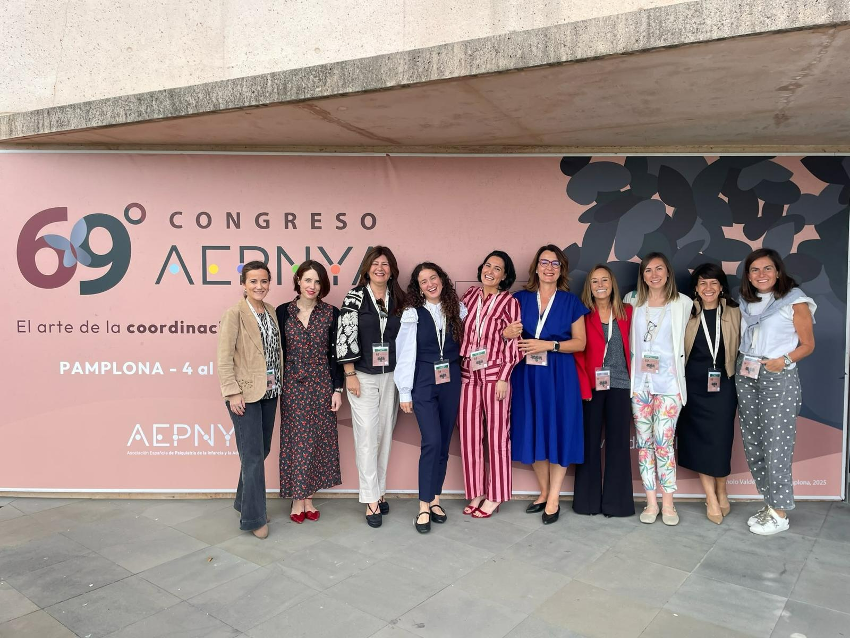
Figure 1: Local Organizing Committee at the front entrance (left-right): Dr. Pilar de Castro, Dr. Sara Antón, Belén Ochoa, Dr. Covadonga Canga-Espina, Dr. María Vallejo-Valdivielso, Dr. Azucena Díez-Suárez, Dr. Montserrat Pàmias, Dr. María Basteguieta, Dr. Olga Torrecilla, Dr. Eva Sesma.
This year's theme was reflected in every aspect of the congress. Rather than focusing solely on psychiatry, the programme highlighted the importance of coordinated work among child and adolescent psychiatrists, psychologists, pediatricians, neurologists, geneticists, nurses, educators and social care professionals. Across plenary lectures, symposia, workshops and Meet the Expert sessions, speakers repeatedly emphasized that improving mental health outcomes requires integrated care extending beyond traditional disciplinary boundaries.
One of the most distinctive features of the meeting was its strong international dimension. Renowned experts from Europe and North America joined leading Spanish clinicians and researchers, providing participants with a truly global perspective on child and adolescent mental health. International speakers included Professor Andrés Martín (Yale Child Study Center, USA), Professor César Soutullo (University of Texas Health Science Center at Houston, USA), Professor Cédric Galera (University of Bordeaux and Charles Perrens Hospital, France), Dr. Manpreet K. Singh (University of California, Davis), and other distinguished invited experts whose contributions enriched discussions on neurodevelopment, psychopharmacology, precision psychiatry, early intervention and translational neuroscience. Their participation reinforced AEPNYA's growing international profile and its close collaboration with leading centers worldwide.
The scientific programme addressed many of today's most pressing challenges, including ADHD, Autism Spectrum Disorder, Eating Disorders, anxiety, depression, early psychosis, suicide prevention, digital mental health, genetics, biomarkers and Artificial Intelligence. Sessions consistently combined advances in neuroscience with practical clinical applications, illustrating how research can directly improve patient care.
One of the most innovative aspects of the Congress was the inclusion of public engagement sessions specifically designed for families and members of the wider community. These highly accessible lectures addressed three of the most common neurodevelopmental and mental health conditions affecting children and adolescents. Professor César Soutullo presented an evidence-based update on ADHD; Dr. Beatriz Martínez discussed current understanding and treatment of Eating Disorders and Dr. Montserrat Pàmias delivered an overview of Autism Spectrum Disorder, emphasizing early identification, multidisciplinary intervention and family support. By opening part of the scientific programme to the general public, AEPNYA demonstrated its commitment not only to professional education but also to improving mental health literacy and reducing stigma within society.
The congress also provided an important platform for scientific exchange among early-career professionals. Oral presentations and poster sessions showcased innovative research from across Spain, stimulating lively discussion and creating new opportunities for collaboration between clinical and academic centers. Mentoring activities further reflected AEPNYA's commitment to supporting the next generation of child and adolescent psychiatrists and researchers.
Beyond the scientific sessions, the meeting fostered meaningful professional connections among participants from Spain and abroad. Informal discussions, networking events and collaborative workshops highlighted the value of international cooperation in addressing increasingly complex mental health challenges. The setting of the Museum of the University of Navarra further reinforced the congress theme by combining science, culture and creativity in an environment that encouraged reflection and dialogue.
The 69th AEPNYA National Congress clearly demonstrated the vitality, scientific excellence and growing international of Spanish Child & Adolescent Psychiatry. By bringing together leading experts from different disciplines and countries, promoting collaboration among clinicians, researchers and families, and opening part of the programme to the wider community, the meeting reflected the values that increasingly define modern mental health care.
More than a forum for presenting scientific advances, the congress embodied the collaborative spirit that contemporary child and adolescent mental health care demands. The connections established and initiatives developed in Pamplona will undoubtedly strengthen future national and international partnerships and further consolidate Spain's contribution to the global child and adolescent mental health community.
Conflict of interest: None declared.
This article represents the view of its authors and does not necessarily represent the view of the IACAPAP's Bureau or Executive Committee.
