

Laying the Foundation for a CAMH Community in Pakistan
By: Samaa Siddiqui1, Huda Faisal1 & Sarah Rizwan11Synapse - Pakistan Neuroscience Institute, Karachi, Pakistan
To say that there is a scarcity of mental health professionals in Pakistan would be an understatement. Our country is the fifth most populous in the world, with 68% of our population being under the age of 30.1 According to the WHO, over 24 million people in Pakistan need psychiatric care, and yet we only have 0.19 psychiatrists for every 100,000 people.2 Within those practitioners, there are currently even less than ten child and adolescent psychiatrists3, and no trained child psychologists for our overwhelmingly young population. Bridging this gap in child and adolescent mental health (CAMH) in Pakistan was not a choice for us at Synapse - it was a need.
The first step in laying the foundation for a CAMH community of practice in Pakistan was addressing the critical gap in training. Currently, Pakistan has no structured training programs focused on building our capacity to work specifically in the field of CAMH.4 It is for this reason that improving training for not just mental health practitioners, but anyone working with children is crucial. This resulted in Synapse organizing the first ever CAMH certificate program in collaboration with the Institute of Business Administration - Centre for Entrepreneurial Development (IBA-CED). Globally, CAMH training programs take on average two to three years longer than training to work with adults. Considering Pakistan does not have any formal training programs in CAMH, our team at Synapse wanted people working in this field to understand the impact of development, trauma, family systems, and a child’s environment on shaping their mental and physical health - not only in the present but also later in their lives. People in Pakistan often assume that children are simply younger versions of adults while in reality, their physical and mental health needs must be addressed by those specialized and competent enough to do so. This is why we at Synapse wanted to highlight that working with children requires much more than just general mental health knowledge and training. Now, more than ever, the need for Pakistan to develop services that are responsible and focused on training for children specifically is immense.
Our efforts to begin to close the gap in the training for CAMH mental health professionals quickly gained traction. Our course had over 50 participants from all over Pakistan and was delivered over 17 weeks by local and global academic faculty who had specific expertise and training in CAMH. Our team at Synapse intentionally designed the curriculum to begin with what we believe is the cornerstone of effective practice within CAMH - an understanding of child and adolescent development. Through our course, we consistently touched upon the idea that child development is a dynamic process rather than a static one. Every year or month may be drastically different from the last when working with children and adolescents.
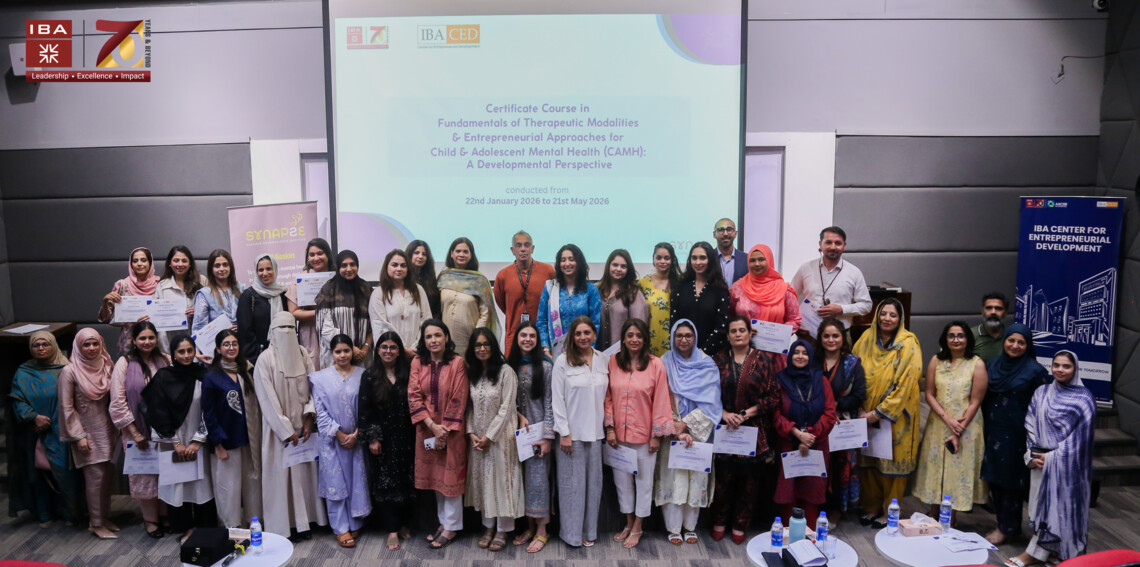
Figure 1: CAMH Certificate Course participants and faculty at the certificate ceremony, IBA City Campus, Karachi, June 2026 (Photo credit: Institute of Business Administration (IBA), Karachi.)
Throughout the duration of the course, participants explored entrepreneurship and research in CAMH, as well as four evidence-based therapeutic approaches: Dialectical Behaviour Therapy (DBT), Regulation-Focused Psychodynamic Therapy (RFPT), Psychoanalytic Therapy, and Family Systems and Therapy. These four modules that were focused on different therapeutic approaches gave a foundational understanding of the modality and its principles. Together, all of the modules were structured in such a way that taught participants to look at CAMH through a developmental lens. The course also enhanced their foundational understanding of practical therapeutic skills, specifically focused on working with children and adolescents. This all came together in tandem in creating the foundation of a CAMH community of practice in Pakistan.
One of our goals that made this program unique was to inculcate the ability to look at CAMH through an entrepreneurial lens. It is clear that the predominantly young population in Pakistan needs more than trained professionals; it needs people who are willing to create new opportunities to improve overall mental wellbeing and service provision for children and adolescents. It is for this reason that we wanted participants to think beyond individual clinical practice. We wanted them to ask themselves: What is missing in my community? How can I build it? Whether that means starting a service, conducting research, or advocating for better care, we wanted participants to see themselves as people who can help shape the future of CAMH in Pakistan.
More importantly, in Pakistan, the absence of a formal CAMH training pathway means that many professionals interested in working with children and adolescents have close to no opportunities to develop specialised competencies, to receive mentorship, or learn evidence-based approaches within a structured program. This is the gap that we at Synapse were trying to fill by not just offering a stand-alone course but by creating a pathway for training within the field of CAMH. By bringing together experts from across disciplines and creating a curriculum grounded in child development, family systems, research, and therapeutic practice, we sought to provide the kind of foundational training that has long been missing. Given that practitioners trained in CAMH are few and far between and the extreme burden on existing mental health resources, our team at Synapse is intentionally mindful that anyone getting trained in our capacity building programs also develops an entrepreneurial mindset. This could be exercising the ability to identify gaps, develop new initiatives, and create sustainable solutions for the CAMH crisis.
Every participant who completed this course is now part of a growing movement to strengthen CAMH in Pakistan. While this is only the beginning, we hope this program marks the first step towards creating a structured training pathway for CAMH in Pakistan and inspires others to invest in the next generation of professionals who will shape the future of mental health care for children and adolescents. While the certificate course has come to an end, one of its most valuable outcomes has been the creation of a CAMH community of practice. By bringing together professionals from mental health, healthcare, education, research, and community development, we hope to foster a space where learning continues beyond the classroom through the exchange of ideas, resources, and experiences.
Strengthening CAMH capacity requires more than training alone. It also requires creating opportunities for professionals to connect, share knowledge, and continue learning from one another. We hope this community of practice we at Synapse have fostered will continue to grow through future learning opportunities, collaboration, and professional dialogue, contributing to a stronger and more connected CAMH workforce in Pakistan.
References
- United Nations Development Programme. Pakistan’s best national investment: Kamyab Jawan [Internet]. 2019 Sep 1 [cited 2026 Aug 10]. Available from: https://www.undp.org/pakistan/pakistans-best-national-investment-kamyab-jawan
- World Health Organization. WHO Pakistan celebrates World Mental Health Day [Internet]. [cited 2026 Aug 10]. Available from: https://www.emro.who.int/pak/pakistan-news/who-pakistan-celebrates-world-mental-health-day.html
- Khan M, Chachar AS, Ali W, Mian A. School mental health best practices institute; capacity building of teachers in mental health literacy in Pakistan. BJPsych Open. 2021;7(Suppl 1):S144. doi:10.1192/bjo.2021.407.
- Hamdani SU, Huma ZE, Tamizuddin-Nizami A. Debate: Child and adolescent mental health services in Pakistan; do we need in-patient mental health facilities for children and young people? Child Adolesc Ment Health. 2021;26(2):182-183. doi:10.1111/camh.12463.
Conflict of interest: The authors declare no conflicts of interest.
This article represents the view of its author and does not necessarily represent the view of the IACAPAP's Bureau or Executive Committee.
