

From Pandemic Innovation to a Global Learning Community: An International Complex Case Conference in Child and Adolescent Psychiatry
By: Salma Malik, MD, MS, DFAACAP, DFAPA1
1Professor of Psychiatry, Frank H. Netter MD School of Medicine, Quinnipiac University
Program Director, Child and Adolescent Psychiatry Fellowship
Institute of Living, Hartford HealthCare, Hartford, Connecticut, USA
Conference at a Glance
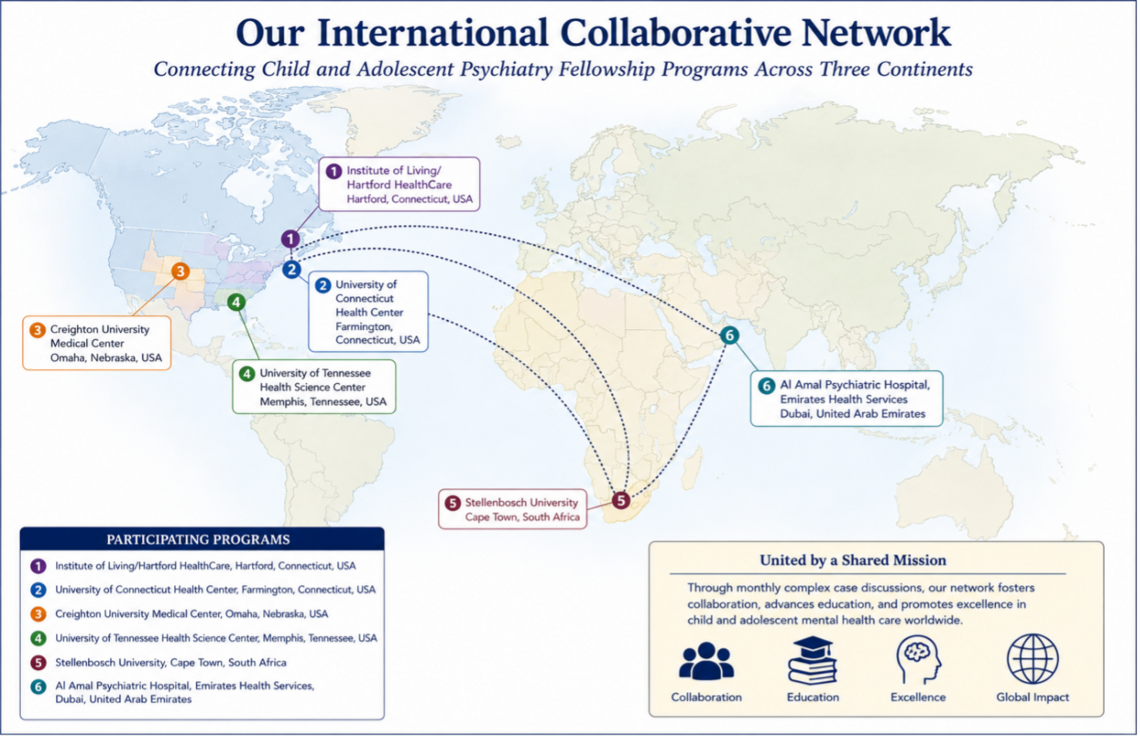
Participating Programs
- Institute of Living/Hartford HealthCare, Hartford, Connecticut, USA
- University of Connecticut Health Center, Farmington, Connecticut, USA
- Creighton University Medical Center, Omaha, Nebraska, USA
- University of Tennessee Health Science Center, Memphis, Tennessee, USA
- Stellenbosch University, South Africa
- Al Amal Psychiatric Hospital, Emirates Health Services, Dubai, United Arab Emirates
Conference Format
- Monthly virtual conference
- Rotating host institution
- Fellow-led presentation of a complex clinical case
- Multidisciplinary expert panel discussion
- Interactive, case-based learning using progressive case disclosure
The COVID-19 pandemic transformed medical education almost overnight. Across the globe, educators were challenged to rapidly transition from traditional classroom teaching to virtual learning. While initially driven by necessity, this shift highlighted an opportunity to rethink how physicians learn and how educational communities can remain connected despite geographical barriers. Rather than simply transferring lectures to an online platform, many programs began exploring innovative teaching models that emphasized collaboration, learner engagement, and critical thinking.
At the Institute of Living Child and Adolescent Psychiatry Fellowship Program at Hartford HealthCare, we embraced this opportunity to redesign our educational approach. Guided by principles of adult learning and case-based education, our faculty developed interactive learning experiences that emphasized discussion, reflection, clinical reasoning, and active learner participation.
Our journey began with a faculty work group dedicated to developing a seminar curriculum using Case-Based Learning (CBL). To better understand educational needs across fellowship programs, we conducted a national needs assessment examining interactive learning within Child and Adolescent Psychiatry (CAP) fellowships. Faculty from more than 50 ACGME-accredited programs participated, with over 90% reporting they were somewhat or extremely motivated to adopt more interactive teaching strategies. These findings reinforced the growing recognition that adult learners benefit most from educational experiences that encourage active engagement, collaboration, and the application of knowledge to authentic clinical problems.
Inspired by these results, faculty from the Institute of Living collaborated with colleagues at the University of Connecticut Health Center, Creighton University Medical Center, and the University of Tennessee Health Science Center to establish a monthly Complex Case Conference. Although conceived during the pandemic, the conference quickly demonstrated educational value that extended well beyond virtual learning and has continued to flourish as an enduring collaborative educational initiative.
Each month, one participating institution hosts the conference. A child and adolescent psychiatry fellow presents a challenging clinical case that is distributed approximately one week beforehand, together with key discussion questions. During the conference, the case unfolds through progressive disclosure, allowing participants to collaboratively develop diagnostic formulations, refine differential diagnoses, explore evidence-based treatment options, and discuss ethical, developmental, family, and systems-based considerations.
The discussions are facilitated by a multidisciplinary panel that includes child and adolescent psychiatrists, psychologists, clinical pharmacists, neuroscientists, researchers, and invited content experts. This collaborative format creates an intellectually stimulating environment where participants learn not only from the presenting case but also from the diverse expertise and perspectives represented across institutions. Fellows are encouraged to question assumptions, defend clinical reasoning, and appreciate the complexity and uncertainty that often accompany child and adolescent psychiatric practice.
The educational model is grounded in established principles of Case-Based Learning and transformative learning theory. Rather than passively receiving information, learners actively construct knowledge by integrating neuroscience, developmental psychopathology, psychopharmacology, psychotherapy, ethics, and family systems into comprehensive clinical formulations. Faculty facilitators guide discussion through thoughtful questioning while allowing learners the opportunity to struggle productively with diagnostic and therapeutic decision-making. This approach promotes critical thinking, reflective practice, and lifelong learning.
Over time, the conference has evolved into much more than a teaching exercise. It has become a vibrant forum for scholarly discussion, faculty development, mentorship, and professional networking. Fellows gain confidence presenting complex cases to an audience of educators from multiple institutions, while faculty exchange educational strategies, discuss challenging clinical scenarios, and develop lasting academic relationships. The conference has fostered an environment where learning occurs not only through expert teaching but also through shared experiences and collaborative problem-solving.
Recognizing the tremendous value of international collaboration, the conference expanded globally two years ago with the addition of the Child and Adolescent Psychiatry program at Stellenbosch University in South Africa. The inclusion of colleagues from South Africa introduced new perspectives on service delivery, healthcare systems, cultural influences, and approaches to caring for children and adolescents in diverse settings. Discussions became even richer as participants explored similarities and differences in clinical practice across countries and considered how social determinants, cultural beliefs, and available resources influence psychiatric care.
Most recently, we were especially delighted to welcome the Child and Adolescent Psychiatry Fellowship Program at Al Amal Psychiatric Hospital, sponsored by Emirates Health Services in Dubai, United Arab Emirates, as the newest member of this international collaboration. Launched in February 2026, this fellowship is the first nationally accredited Child and Adolescent Psychiatry Fellowship in the United Arab Emirates, representing an important milestone in the advancement of subspecialty psychiatric training within the region.
The addition of the Dubai fellowship further strengthens our shared commitment to building a truly global community of child and adolescent psychiatry educators and trainees. Fellows and faculty now learn from healthcare systems spanning North America, Africa, and the Middle East. Discussions routinely incorporate cultural perspectives, family structures, healthcare policy, resource availability, and innovative approaches to child and adolescent mental healthcare. Beyond enriching clinical education, these partnerships create exciting opportunities for collaborative scholarship, faculty development, research initiatives, curriculum innovation, and future global mental health projects.
Today, the International Complex Case Conference demonstrates how technology can bring together educators and trainees across continents in meaningful and enduring ways. Despite differences in geography, healthcare systems, and available resources, participants share a common commitment to improving the mental health and well-being of children and adolescents worldwide. The conference provides a welcoming environment where curiosity, humility, and mutual respect foster learning across cultures and disciplines.
What began as an innovative response to the educational challenges of COVID-19 has grown into a sustainable international network dedicated to excellence in child and adolescent psychiatry education. More importantly, it has created a community of educators and trainees who learn with and from one another. As the collaboration continues to expand, we look forward to welcoming additional training programs from around the world. We hope this initiative will continue to strengthen international partnerships, inspire educational innovation, and prepare future child and adolescent psychiatrists to provide compassionate, evidence-informed, and culturally responsive care for children, adolescents, and families across diverse setting
Acknowledgements
The author gratefully acknowledges the program directors, faculty, fellows, and multidisciplinary panel members from all participating institutions whose enthusiasm, generosity, and commitment have made the International Complex Case Conference a vibrant and enduring educational collaboration.
Special thanks to:
- Institute of Living/Hartford HealthCare: Salma Malik, MD
- University of Connecticut Health Center: Asima Zehgeer, MD
- Creighton University Medical Center: John (Tony) Pesavento, MD
- University of Tennessee Health Science Center: Allison Ford, MD
- Stellenbosch University, South Africa: Anusha Lachman, MBChB, PhD
- Al Amal Psychiatric Hospital, Emirates Health Services, UAE: Meshal A. Sultan, MD
Conflict of Interest: The author declares no conflicts of interest related to this article
This article represents the view of its author and does not necessarily represent the view of the IACAPAP's Bureau or Executive Committee.
