

A New Era in Child & Adolescent Mental Health Education: J.M. Rey’s E-Textbook 2.0
By: Uttara Chari1, Hee Jeong Yoo2, Valsamma Eapen3, John-Joe Dawson-Squibb4
1Associate Professor of Clinical Psychology, St. John’s National Academy of Health Sciences, Bengaluru, India
2Professor of Psychiatry, Seoul National University College of Medicine, Seoul,National University Bundang Hospital, South Korea
3Chair, Infant, Child and Adolescent Psychiatry, Head, Academic Unit of ChildPsychiatry and Clinical Academic, South West Sydney Local Health District,Professor, Discipline of Psychiatry and Mental Health/School of ClinicalMedicine, UNSW Medicine & Health, Australia
4Clinical Psychologist, Division of Child and Adolescent Psychiatry, Red CrossChildren's Hospital, Department of Psychiatry and Mental Health, University ofCape Town, South Africa
The J.M. Rey’s IACAPAP e-Textbook of Child and Adolescent Mental Health was officially launched in 2012 at the IACAPAP World Congress in Paris. Since then, it has become one of the main academic references for child and adolescent mental health across the globe.
The task of updating this textbook was undertaken in 2022; with a change in the core editorial team. An update was necessary given advances in information technology, digital accessibility, science of child and adolescent mental health, care and treatment. The aim was to have a textbook, accessible on a digital platform, offering individualized reader experience, and scope to readily update content as advances in child and adolescent health care are reported. With these aims, the textbook was geared to have more audio-visual content, with access to other websites. Readers were to also be provided with personal logins that would allow them to bookmark, highlight, make notes, and utilize audio narration of the content. Of course, keeping with the vision of the original textbook, the content was to be more relevant for readers across the globe; from laypersons to mental health professionals.
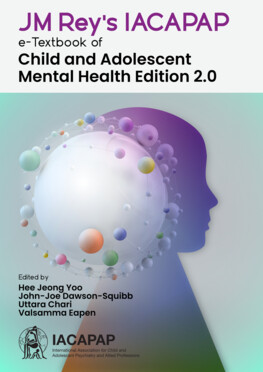
The table below outlines the timeline in the textbook updating process. In the updated textbook, we have sought to bring about a more coherent organization – major sections > subsections > chapters. As it stands currently, the updated textbook has 3 major sections > 15 subsections > 59 chapters. This is a transition from 10 sections and 64 chapters, in the original e-textbook. We have sought to introduce reflective learning as part of the textbook, via the inclusion of multiple-choice questions at the end of every chapter. Also, attempts have been made to enhance learning through inclusion of case illustrations, with opportunities to apply text material to clinical encounters.
Behind the Scenes - A glimpse into the updating process timeline
| June 2022 - December 2022 |
|
| January 2023 - June 2023 |
|
| July 2023 - December 2023 |
|
| January 2024 - December 2024 |
|
| January 2025 - December 2025 |
|
| January 2026 - June 2026 |
|
| July 2026 |
|
As the J.M. Rey’s IACAPAP e-Textbook of Child and Adolescent Mental Health 2.0 is set to launch at the 27th World Congress in July 2026, at Hamburg, Germany; the editors are immensely grateful to the IACAPAP Bureau for their unwavering support and encouragement. A special note of appreciation is extended to Ms. Sue Wong, Executive Officer at IACAPAP, whose organizational skills ensured that work on the textbook progressed systematically. The editors are especially grateful to the authors for volunteering their time and attention to updating/drafting chapters; and their patience through inadvertent lapses and delays. We also acknowledge the contribution of editorial team members, early career mentees, and prior IACAPAP administrative staff who helped review, edit and upload chapters. This journey shall continue beyond the official launch. Whilst challenges persist – coordinating across time zones, time commitments in the background of fulltime employment of all chief editors, loss of editorial team members, technological glitches – we strive to have all the textbook chapters online by year end.
This article represents the view of its author and does not necessarily represent the view of the IACAPAP's Bureau or Executive Committee.
